It is a scenario every electrical engineer and maintenance technician faces eventually: You have a critical DC motor or battery bank failure, but the only replacement part on the shelf is a standard AC contactor. Can you use it?
The short answer is yes, but only with severe derating and specific wiring modifications.
Using an AC kontaktor for a DC load without understanding the physics of electrical arcing is a recipe for equipment failure, electrical fires, and safety hazards. While AC and DC contactors share similar electromechanical principles, their ability to handle the “break” of a circuit differs fundamentally.
This guide provides the engineering data, derating formulas, and arc suppression techniques required to safely adapt AC contactors for DC applications when a dedicated A DC kontaktor is unavailable.
A legfontosabb tudnivalók
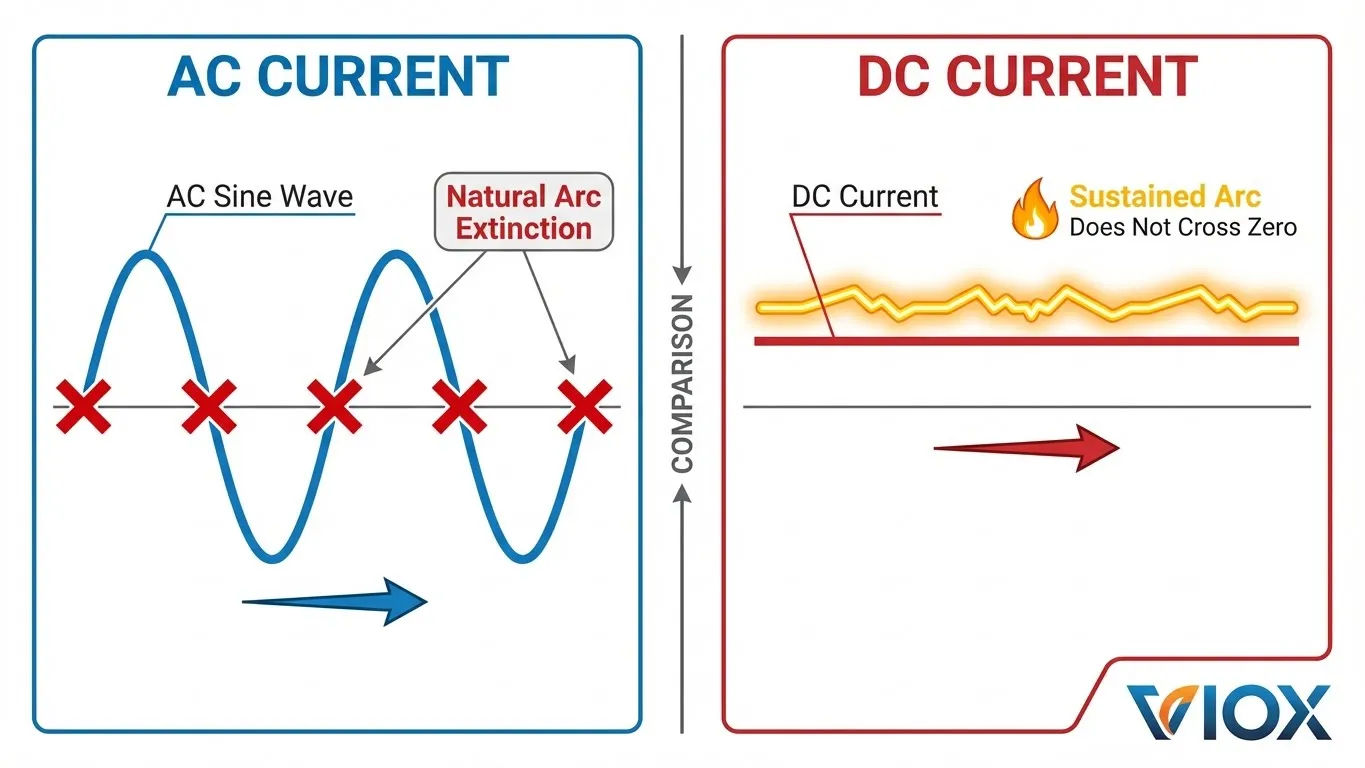
- Zero-Crossing Factor: AC current naturally extinguishes arcs 100-120 times per second; DC current does not, leading to sustained, destructive arcing.
- Derating Rule of Thumb: An AC contactor typically retains only 10-15% of its voltage rating és 50-60% of its current rating when used for DC.
- Series Connection Strategy: Wiring multiple poles in series significantly increases the DC voltage breaking capacity.
- Arc Suppression is Mandatory: External snubbers or flyback diodes are required to protect contacts and coil drivers in DC circuits.
- Emergency Use Only: AC contactors should only be used for DC loads as a temporary measure or within strict low-voltage limits.
Understanding the Core Difference: AC vs DC Arc Behavior
To understand why swapping contactors is dangerous, you must understand the arc. When contactor contacts open under load, the air between them ionizes, creating a plasma arc that continues to conduct electricity until the gap is wide enough to break it.
The AC Advantage: Zero-Crossing
Alternating Current (AC) follows a sine wave. In a 50Hz or 60Hz system, the current drops to zero volts 100 or 120 times per second, respectively. During these “zero-crossing” moments, the arc naturally extinguishes. The contactor only needs to prevent the arc from re-striking.
The DC Challenge: The Continuous Arc
Direct Current (DC) is continuous. There is no zero-crossing point. When contacts open, the arc is sustained by the constant voltage pressure. It acts like a plasma torch, generating immense heat (up to 20,000°C in the arc core). Unless the gap is widened rapidly or the arc is forced out by magnetic blowouts, it will melt the contacts and destroy the device.
Why AC Contactors Fail in DC Applications
When an AC-rated contactor is forced to switch a DC load without modification, three catastrophic failure modes typically occur:
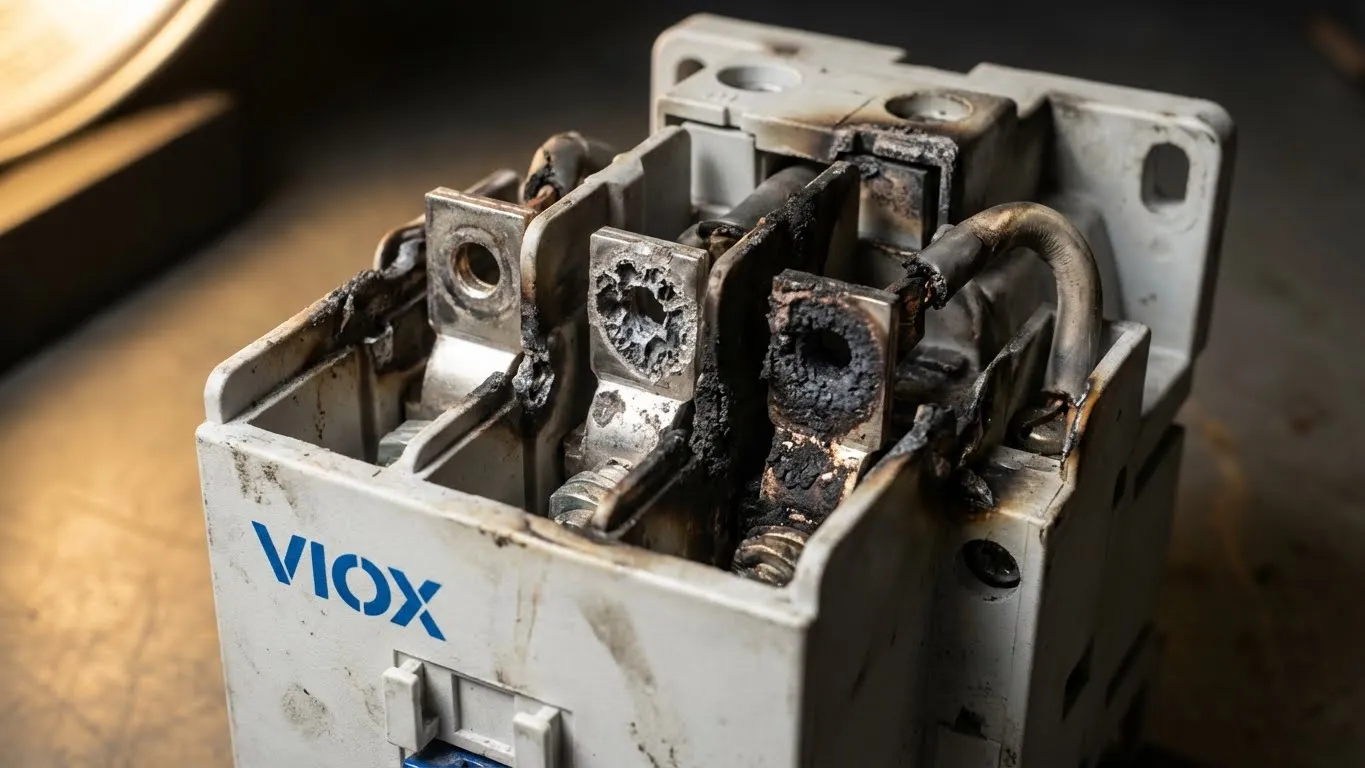
- Kontaktushegesztés: The sustained heat from the DC arc melts the silver alloy on the contact tips. When the contactor tries to close again (or if the spring pressure fails), the contacts fuse together.
- Arc Chute Failure: AC contactors use simple metal splitter plates to cool arcs. These are insufficient for DC arcs, which can burn through the plastic housing and jump to adjacent phases or the enclosure ground.
- Material Transfer: In DC circuits, metal ions migrate in one direction (from anode to cathode). This creates a “pip and crater” effect, where one contact builds up material while the other pits, drastically shortening electrical life.
For a deeper dive into contactor construction, read our guide on AC vs DC kontaktorok: Típusaik és funkcióik megértése.
Derating Guidelines for DC Use
If you must use an AC contactor for a DC load, you cannot use the nameplate ratings. You must derate the device.
The Voltage Derating Rule (10:1 Ratio)
The most critical limitation is voltage. An AC contactor relies on the zero-crossing to break high voltages. Without it, the gap is too small.
- Ökölszabály: An AC contactor is typically effective for DC loads only up to 10-15% of its AC voltage rating.
- Példa: A contactor rated for 400V AC is often only safe for 24V DC to 48V DC loads using a single pole.
The Current Derating Rule
Current handling is less affected than voltage but still requires reduction due to the increased heat generated by the DC arc.
- Resistive Loads (DC-1): Derate to 80-100% of AC-1 rating (only at low voltages).
- Inductive Loads (DC-3/DC-5): Derate to 30-50% of AC-3 rating.
Increasing Capacity: Wiring Poles in Series
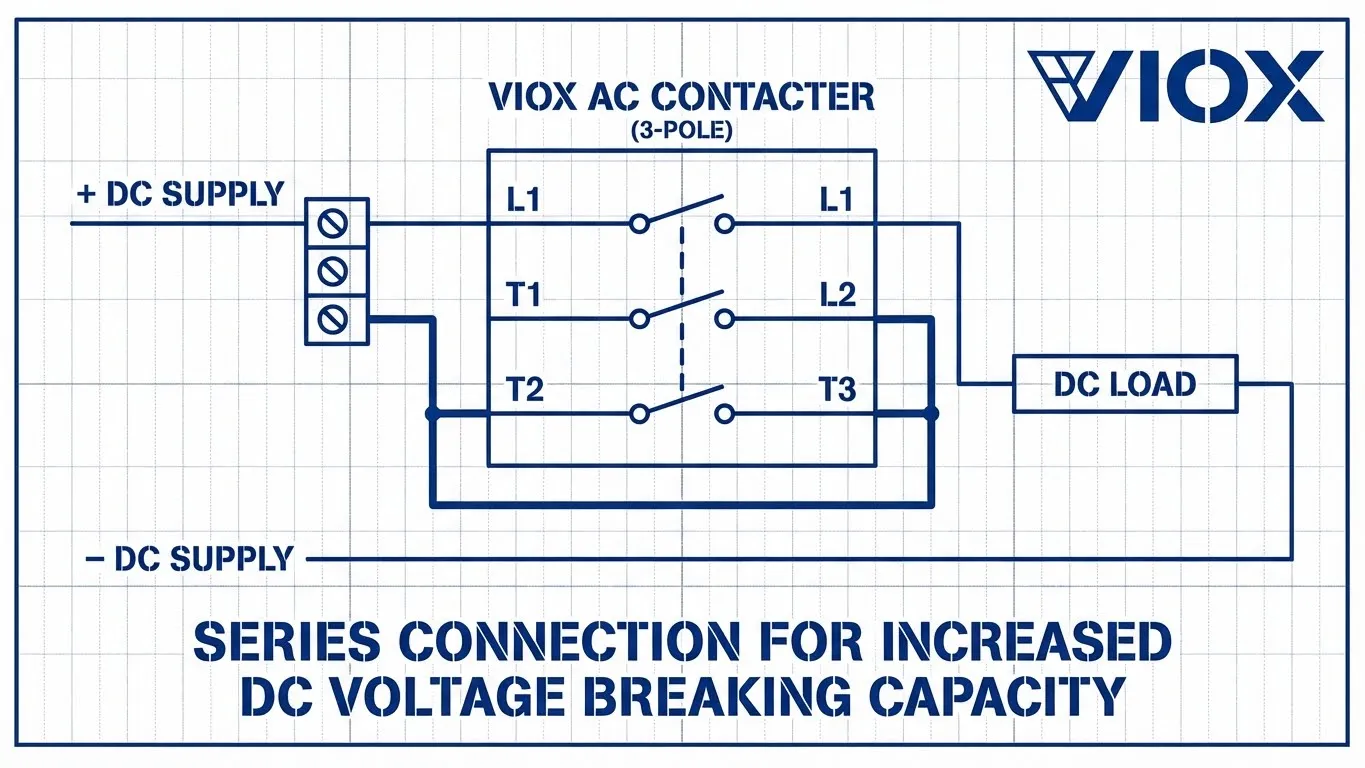
The most effective way to improve DC performance is to wire the contactor’s power poles in series. This effectively multiplies the contact gap distance, allowing the arc to be stretched and extinguished more easily.
- 1 Pole: 24V DC / 100% Current
- 2 Poles in Series: 48V DC / 100% Current
- 3 Poles in Series: 110V DC / 80% Current (Check manufacturer specs)
Arc Suppression Techniques for DC Applications
Derating handles the “break,” but arc suppression protects the contacts and the control coil. When a DC coil is de-energized, the collapsing magnetic field generates a voltage spike (Back EMF) that can reach hundreds of volts, damaging control electronics (PLCs) or welding control contacts.
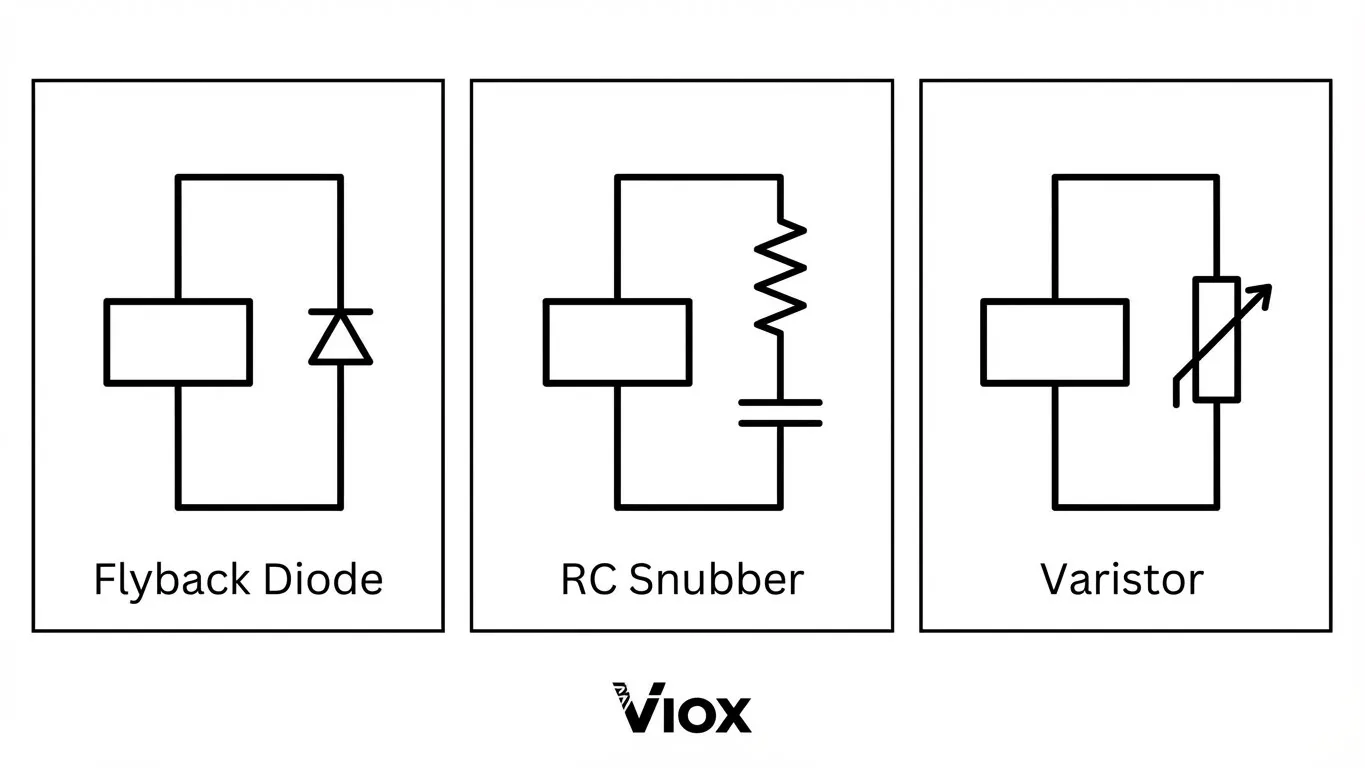
1. Flyback Diode (For DC Coils)
- Funkció: Provides a path for the inductive current to recirculate and dissipate when the coil is turned off.
- Előnyök: Simple, cheap, effective.
- Hátrányok: Slightly delays the drop-out time of the contactor (by 10-50ms), which can be an issue in precise timing applications.
- Telepítés: Wired in parallel with the coil, in reverse bias (Cathode to Positive).
2. RC Snubber (Resistor-Capacitor)
- Funkció: Absorbs the energy of the voltage spike.
- Előnyök: Works for both AC and DC coils; does not significantly delay drop-out time.
- Hátrányok: Must be sized correctly for the specific load inductance.
3. Varistor (MOV)
- Funkció: Clamps the voltage spike at a specific level.
- Előnyök: Fast response, high energy absorption.
- Hátrányok: Degrades over time with repeated spikes.
Comparison Table: AC Contactor vs DC Contactor
Before making a substitution, compare the capabilities. Note that Electrical Standards for Contactors differ significantly between IEC AC and DC categories.
| Jellemző | AC Contactor (Standard) | DC Contactor (Specialized) |
|---|---|---|
| Arc oltás | Zero-crossing dependent; simple splitter plates. | Magnetic blowouts, vacuum bottles, or wide gaps. |
| Kapcsolattartó anyag | Silver-Nickel or Silver-Cadmium Oxide. | Silver-Tungsten (harder, resists welding). |
| Tekercs kialakítása | Laminated core (reduces eddy currents). | Solid core (higher efficiency for DC). |
| Feszültség Értékelés | High (up to 1000V AC). | High (up to 1500V DC). |
| AC Contactor on DC Load | Derate Voltage by ~90%. | N/A |
| Tipikus Alkalmazás | Motors, HVAC, Lighting. | EV Charging, Solar PV, Battery Banks, Rail. |
When Derating Isn’t Enough: Safety Risks
Using a derated AC contactor is a “band-aid” solution. It introduces risks that professional engineers must document:
- Reduced Electrical Life: Even with derating, the lifespan of an AC contactor in a DC application may drop from 1 million operations to fewer than 50,000.
- Tűzveszély: If the load inductance is higher than calculated (common with DC motors), the arc may not extinguish, leading to a “standing arc” that melts the contactor housing.
- Warranty Void: Using a VIOX or any other manufacturer’s AC contactor for DC loads outside of specified DC-1/DC-3 ratings typically voids the warranty.
For high-voltage DC applications like solar combiners, always use purpose-built protection. See our guide on DC Isolator vs. DC Circuit Breaker for proper selection.
The Right Solution: DC-Rated Contactors
For reliability, especially in solar, EV, or heavy industrial DC applications, a dedicated DC contactor is non-negotiable.
VIOX DC Contactors jellemzői:
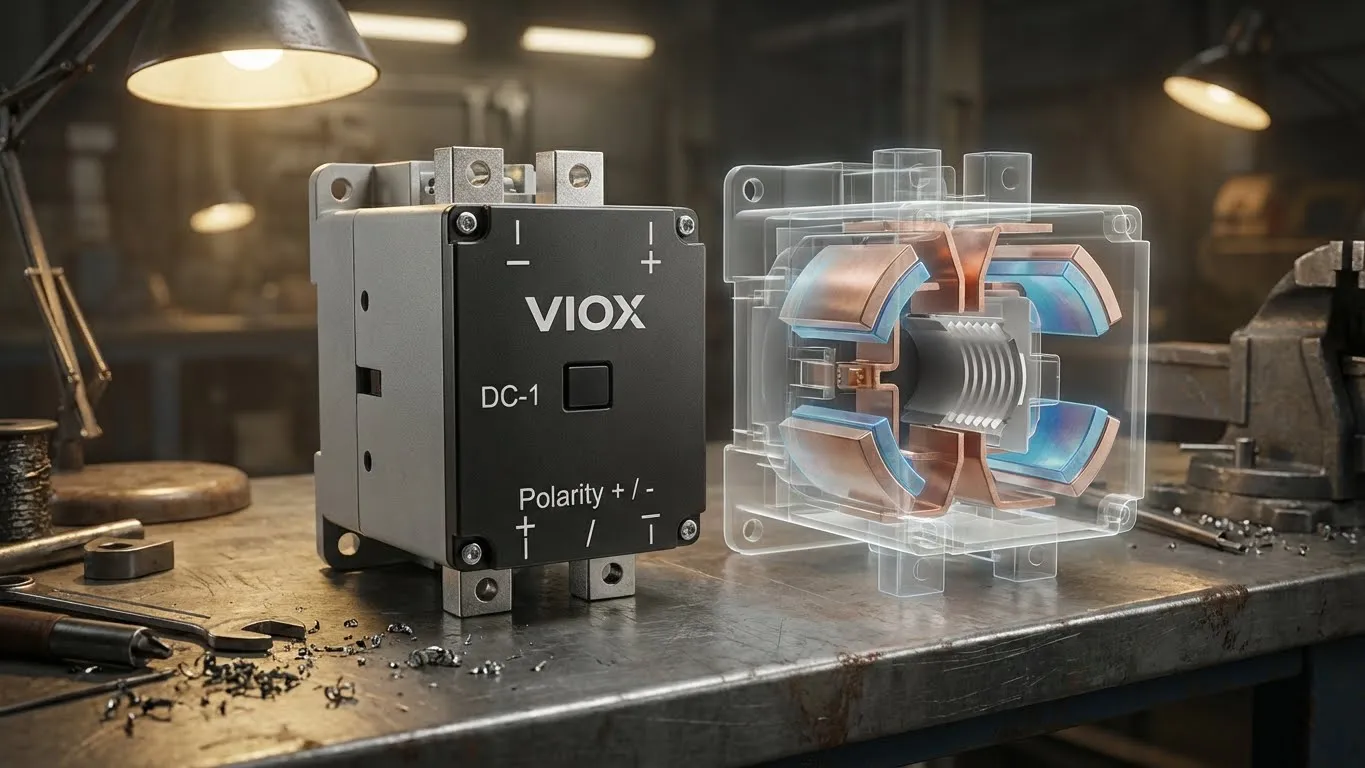
- Mágneses kifúvók: Permanent magnets located near the contacts push the arc outward, stretching it until it snaps.
- Gas-Filled Chambers: Some models use inert gas (like hydrogen or nitrogen) to inhibit oxidation and cool the arc.
- Polarized Terminals: Designed specifically to direct the arc into the chute.
If you are unsure about the health of your current equipment, learn Hogyan kell tesztelni egy kontaktor before putting it back into service.
GYIK Szekció
Can I use an AC coil contactor with a DC power supply?
No, not directly. An AC coil has low resistance and relies on inductive reactance to limit current. If you connect it to DC, it will act as a pure resistor (with very low resistance), draw excessive current, and burn out the coil within seconds. You must use a resistor in series or a specific DC coil.
What is the “Rule of Thumb” for using AC contactors on DC?
The general rule is that an AC contactor can handle DC voltage equal to roughly 10% of its AC voltage rating (e.g., 240V AC -> 24V DC) while maintaining the same current rating for resistive loads.
Why do DC contactors have polarity markings?
DC contactors often use magnetic blowouts to push the arc into an extinguishing chute. This magnetic force is directional. If you wire it backward, the magnet will pull the arc a the mechanism rather than pushing it out, likely destroying the contactor.
Can I use a capacitor to suppress DC arcing?
A capacitor alone is risky because it can cause high inrush current when contacts close (welding them). A Snubber (Resistor + Capacitor) is the correct approach, as the resistor limits the discharge current.
Is a DC Circuit Breaker the same as a DC Contactor?
No. A DC megszakító is a safety device designed to trip during faults (overload/short circuit). A contactor is a control device designed for frequent switching (thousands of cycles). Do not use a breaker as a primary switch.
What happens if I don’t use a flyback diode on a DC coil?
Without a diode, the collapsing magnetic field can generate a voltage spike of 500V-1000V. This can arc across the switch controlling the coil or destroy the transistor/PLC output driving it.
Need specific DC switching solutions? VIOX Electric manufactures a complete range of IEC-certified DC contactors and circuit protection devices. Lépjen kapcsolatba mérnöki csapatunkkal for sizing assistance.